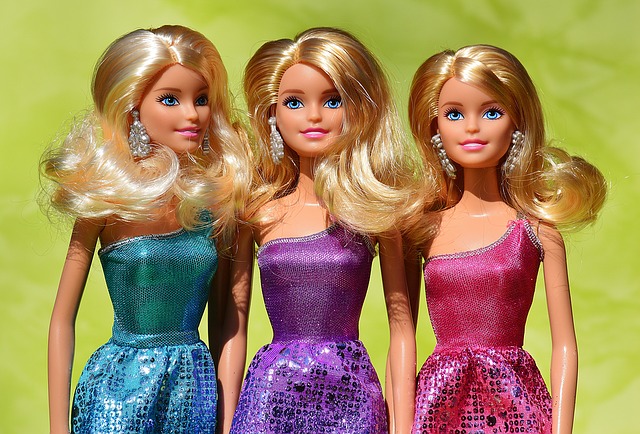
Barbie and Balmain Pair Up for Couture NFT Project

Barbie, the quintessential American toy by Mattel, announced a partnership with French fashion powerhouse Balmain.

This collaboration is surprising on many levels. First, there is no actual doll involved. Second, the collection is a mix of real fashion and NFTs.

The collection includes 50 adult garments inspired by the iconic Barbie doll. Avatars of diverse racial backgrounds model the clothes, and three NFTs of unique looks are being sold at auction.  Barbie is extending its efforts into the realm of virtual collectibles as each NFT includes a doll-sized physical design. The entire collection and the NFT designs are unisex: there is no more Barbie and Ken, just high-end fashion for all.

Mattel also has a partnership with Gucci to create Hot Wheels Collectibles.

Recycled Footwear Takes a Step Forward

Rothy’s, the American eco-friendly shoe brand, has gotten a significant investment from the owner of Havaianas. Based in San Francisco, California, and valued at $1 billion, Rothy’s also produces purses, bags, wallets, and men’s loafers, all from recycled and marine plastic.

Over the last few years, investors and customers have paid more attention to the environmental and social impact of the companies they back or buy. AllBirds, another sustainable shoe and fashion company, made a 2021 IPO valued at $4 billion.

Rothy’s was founded by Stephen Hawthornthwaite, chief executive, and Roth Martin, president. They remain significant owners and are involved in operational oversight.

Economic Status: Biden’s First Quarter

How does the economy look after President Joe Biden’s first quarter?  There is some good and some not-so-good.  Here we take a look.

The Bureau of Economic Analysis  reported a slightly faster rate of growth seen by more consumer spending (notably going out to eat, traveling, etc.) inventory investment and exports, marking the second time the growth pace was revised higher in the quarter. 

Between April and June, GDP expanded at 6.7% which was a little higher than the earlier estimates of 6.5%.

The PCE Price Index  however was remained at a disappointing 6.5% which is the highest that it has been since the early 1980s.

According to Action Economics Chief Economist Mike Englund, expectations were not met which he believes is due to “supply chain disruptions, which actually become more severe in Q3.”

One of the problems currently plaguing America is scarce labor, thanks in part to the exodus of many workers across industries.

Promoting Competition in the US Economy

Earlier this month, President Biden signed an Executive Order to “promote competition in the American economy.”  This seeks to decrease costs for families while increasing salaries, promote innovation and ultimately result in faster economic growth.

The idea behind this order is a “decisive action” on the part of Biden to somehow decrease the trend that has been escalating in the creation of corporate consolidation and increase realistic competition, putting consumers, farmers, workers and small businesses in the driving seat.  The Executive Order features 72 initiatives undertaken by over a dozen federal agencies who will be expected to counter some of the most worrisome competition issues nationwide.  Ultimately – once they are fully in place – people’s quality of lives will be enhanced.

Too many people were hit financially hard by the pandemic.  With this Executive Order strategic action is meant to provide hope for people seeking to start a business, grow a business or even get a better job. The Order has many features.  Some of these are:

  1. The banning/limiting of non-compete agreements and bureaucratic occupational licensing requirements which hinder economic flexibility. This should help people change jobs more easily.
  2. Sell hearing aids over the counter, saving thousands of dollars for hearing-impaired.
  3. Enforce clear disclosure of add-on fees from airlines, making it easier for consumers to get refunds.
  4. Help federal agencies promote greater competition via their spending decisions and thus increase opportunities for small businesses.
  5. Augment the Department of Agriculture’s tools, empowering farmers, increasing their wages and ending the abusive practices of some meat processors.

As Biden said in his recent White House Briefing,

“The heart of American capitalism is a simple idea: open and fair competition — that means that if your companies want to win your business, they have to go out and they have to up their game; better prices and services; new ideas and products. That competition keeps the economy moving and keeps it growing.  Fair competition is why capitalism has been the world’s greatest force for prosperity and growth.”

Let’s hope the Executive Order works the way it has been intended. 

Construction Industry

America’s construction industry – as we have seen since the start of the pandemic – is thankfully thriving. According to a recent article in For Construction Pros:

“Despite the influence of the COVID-19 pandemic, the December 2020 figure was 5.7% above December 2019’s estimate of $1,410.3 billion. The value of construction in 2020 was $1,429.7 billion, 4.7% above the $1,365.1 billion spent in 2019, led largely by solid growth in the residential construction segment.”

There are many construction projects taking place in America at all times.  Storage, infrastructure and new buildings will always be needed.  Forecasts for 2020-26 in North America indicate that there will be a “healthy growth rate” in construction equipment rental industry which will reach $55bn by 2026. However, this sector was negatively impacted by coronavirus and lockdowns which prevented such companies from operating.

However, Chief Economist at Dodge Data & Analytics, Richard Branch writes:

“While the recovery is underway, the road to full recovery will be long and fraught with potential potholes. After losing an estimated 14% in 2020 to $738 billion, total construction starts will regain just 4% in 2021.”

There will be a rise in single unit home construction starts Branch believes by around 7 percent this year.  But multi-family homes he believes “will pay the price for single family’s gain” as the dollar value of these is predicted to drop by 1 percent this year.

So there is still recovery needed. But overall – and especially compared to other industries – the pandemic has definitely not been the worst for America’s construction industry.

Current Economics of US Oil

While there are many US industries that are struggling to maintain their normal business activities (if they have not collapsed altogether), there are some which are thriving during this pandemic. One of them is oil which has been seen to make a comeback, at least from an initial superficial glance.

Brent cruse’s barrel price increased to over $60 for the first time in over 12 months.  In addition, cobalt and lithium (among other battery metals) have seen a price increase alongside copper and nickel which has gone up even more. This is definitely good news but according to experts, not yet quite reason to celebrate a return to normal times.

According to forecasts from the American Petroleum Institute, the industry could encounter up to a million loss in jobs by 2022 as well as $9 billion risk to government revenue and American households having to spend $19 billion more on energy by 2030. Some states will be even more negatively impacted such as New Mexico and Wyoming which are likely to not only lose “thousands of industry jobs and access to affordable energy, but also billions in state revenue that could hurt public services, schools, infrastructure and health care.”

Auction Theory Culminates in America’s Nobel Prize Win

Two economists from Stanford University were the recipients of this year’s Nobel Prize in Economic Sciences.  Scientists Paul R. Milgrom and Robert B. Wilson received the prize for the “improvements [they had made] to auction theory and [the] invention of new auction formats.”  Furthermore, their work has – and will be – beneficial to buyers, sellers and taxpayers globally.

These auction formats can be used for both goods and services which are hard to sell in any of the conventional avenues.  Two examples of this are radio frequencies and the volume of minerals in a specified area.

During the Pandemic are Any Industries Thriving?

Pretty much all the business and economic news over the last few months has simply been dire and grim to say the least.  People and executives worldwide are despairing, feeling hopeless, wondering if they will ever get back into business again let alone thrive.  Somehow though, some industries actually are thriving.  Here, we take a brief look at three of them.

The first one is obvious: industrial cleaning chemicals.  According to the Global Industrial Cleaning Chemicals Market, the industry size was measured at $16290m.  By the end of 2026 it is anticipated that this figure will increase to $20930m.  between 2021 and 2026, the CAGR will be 3.6 percent.

The second industry that is thriving and is predicted to continue to grow during the next few years is the delivery and takeout food. While it is anticipated that the restaurant industry will suffer a huge loss in the foreseeable future, take out food will have the opposite effect.  One particular example of this is Beyond Meat, which has encountered a soaring of 194.9% in grocery sales during Q2 2020.

A third industry is the hair dyeing market.  During the lockdowns people had to figure out what to do with their hair on their own – many for the first time ever. Experimenting with DIY hair dyeing kits became the norm and many of the big names such as Estee Lauder, Avon Products and L’Oreal witnessed an increase in sales in this area.

Change in US Electricity Sources

Government predictions are indicating that in an unprecedented move, US electricity will likely be sourced more heavily from renewable power than coal. The reasoning behind this is partly due to COVID-19 and will have significant ramifications in the fight against climate change.

This marks a substantial change from the situation of 10 years ago when coal provided almost 50 percent of America’s electricity. In addition, it is within the backdrop of the current government’s effort to help the industry by diminishing pollution regulations on coal-burning power plants.

According to the Institute for Energy Economics and Financial Analysis (based on data from the US Energy Information Administration), since March 25, renewable energy sources have been manufacturing more electricity than coal power in the US. The following is a statement from the IEEFA

“The transition away from coal for electricity generation has accelerated in 2020 due to a number of factors, particularly low gas prices, warmer weather, a significant amount of new renewable capacity connecting to the grid late last year, and more recently, lower power demand from the economic slowdown because of the coronavirus.”

America’s Manufacturing Sector: Good, Bad or Somewhere in Between?

The manufacturing industry in the US has gotten a bad rep over the last few years.  On and off.  It’s hard to determine where it stands today but in this article we will take a look at some of the more accurate indicators.

From around June 2019, a recessional atmosphere occurred in the industry.  But that turned around in January according to a report from the Institute of Supply Management.  The report showed a jump in purchasing manufacturing index to 50.9 – even higher than predictions of 48.5.  According to NY’s ING’s Chief Economic Strategist, James Knightly:

“It seems likely that the phase one trade deal with China has generated a positive lift for the sector by giving some certainty that there will be no more tariffs, at least in the near term.”

Furthermore, it is believed that 2020 will “likely be a better year for US manufacturers,” due to the stabilization of international growth and the light at the end of the tunnel for domestic economic activity.

On the other hand, Anneken Tappe of CNN Business would have us believe that “America’s manufacturing sector is in a recession.”  But, she adds, “that is only part of the story,” and illustrates how two factors are at play here: the expansion of factories and their recession. In 2008, the manufacturing industry began its road to recovery, adding around 1.4 million jobs. But still, it has been dipping for the last 40 years.  

So that’s the current summary of the good and bad in America’s manufacturing sector.